
The Problem With Being Extraordinary
Gareth Bale scored one of the greatest goals in Champions League final history. He delivered the most important goal in Welsh football history. He won five European Cups. He terrorised the best defenders in the world for fifteen years with a combination of pace, power and technical quality that genuinely had no equal in the game during his peak years. And yet, when people discuss the greatest players of his generation, his name arrives as an afterthought — mentioned after Messi, after Ronaldo, after Neymar, sometimes after players who won a fraction of what Bale achieved.
Sponsored
DAZN – Watch Every Match
Stream live football on any device
The story of Gareth Bale is one of the most fascinating and frustrating in the history of modern football. A player of absolutely extraordinary ability who was systematically underappreciated, misunderstood and ultimately defined by controversies and setbacks rather than by the genuinely historic moments of brilliance that should be his lasting legacy. This is an attempt to correct that record.
What He Could Actually Do
Before we discuss the noise, let us discuss the football. Because at his peak — roughly 2010 to 2018 — Gareth Bale was doing things on a football pitch that essentially nobody else in the world could do. The combination of attributes he possessed was genuinely unique. He was the fastest player in the world over twenty to thirty metres during that period — not just one of the fastest, the fastest. He had the upper body strength of a centre-back, allowing him to hold off defenders who threw their entire bodies at him. He had a left foot of such precision and power that goalkeepers genuinely feared his set-pieces from forty yards. And he had the footballing intelligence to combine all of these qualities into moments that changed matches.
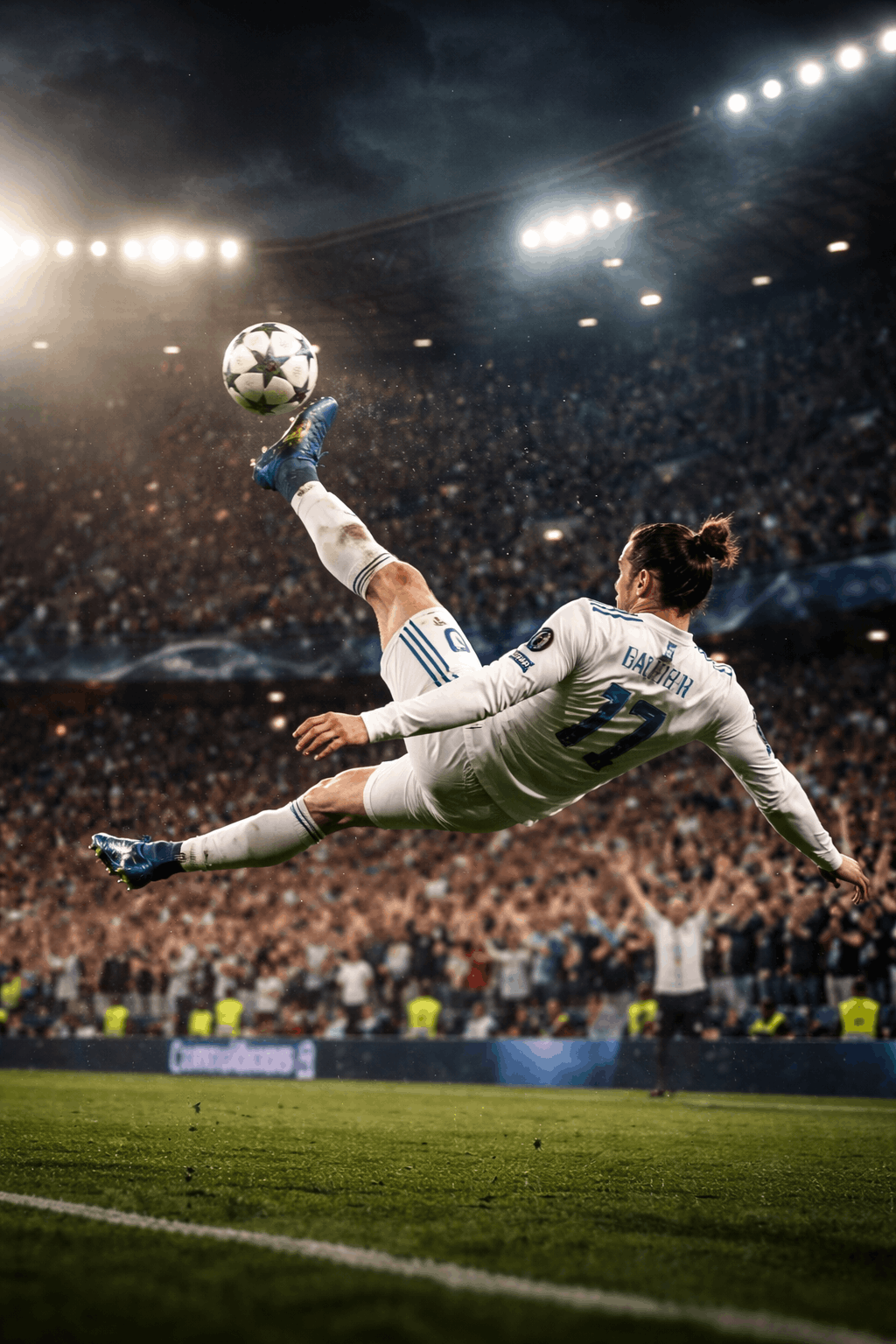
The goal against Inter Milan in 2010 — sprinting seventy metres with Maicon, one of the best right backs in the world, clinging to his back and simply being outrun — announced Bale to the world with a clarity that required no translation. The goal in the Copa del Rey final against Barcelona — a solo run that covered sixty metres at a speed that made professional footballers watching in stadiums look stationary — was a piece of athleticism so extreme it seemed impossible. The bicycle kick in the Champions League final against Liverpool in 2018 — technically, arguably the greatest goal ever scored in a Champions League final — was the work of a player operating at a level that transcended normal human physical limitation.
The Madrid Years — Brilliance Buried in Politics
Gareth Bale joined Real Madrid in 2013 for what was then a world record fee and spent nine years at the club, winning five Champions League titles. By any objective measure, that is an extraordinary career achievement. Five European Cups. La Liga titles. Copa del Rey winners' medals. More silverware than most players accumulate in an entire career. And yet the Madrid years are remembered more for the golf controversies, for the tense relationship with Zinedine Zidane, for the Wales-Golf-Madrid flag and the perceived lack of effort in training than for the goals that won trophies.
This is one of the great injustices in modern football coverage. Bale's struggles at Madrid were real — injuries became chronic from his late twenties onwards, his relationship with the club and manager deteriorated, and his public persona became increasingly defensive and withdrawn as the pressure intensified. But the narrative that developed around him — that he was lazy, uncommitted, more interested in golf than football — was grotesquely unfair to a player who was dealing with serious physical problems that limited his ability to train and play consistently.
The reality is more complicated and more sympathetic. Bale was a player whose body simply could not sustain the physical demands his extraordinary athleticism placed upon it. The injuries were not the result of poor preparation or lack of commitment. They were the inevitable consequence of a player generating forces through his tendons and muscles that the human body was not designed to withstand week after week. The golf was not laziness — it was a low-impact sport that kept a player mentally healthy during the long periods when football was not possible. The context matters enormously. The narrative ignored it entirely.
Wales and the Moments That Defined a Nation
If the Madrid years were complicated, Bale's international career with Wales was nothing short of remarkable. He almost single-handedly carried a national team of limited collective resources to places they had no right to reach on talent alone. The Euro 2016 campaign — Wales reaching the semi-finals, Bale scoring extraordinary goals, an entire nation experiencing the kind of football joy that had been absent for decades — was one of the most emotional stories in the history of the European Championship.
Sponsored
Opta Stats Pro
Advanced football stats and data
Then came the 2022 World Cup qualification. Bale's goal and performance in the playoff final against Ukraine, securing Wales's first World Cup appearance in 64 years, was a moment of such magnitude for a football-obsessed nation that it transcended sport entirely. This was a player dragging a country to the biggest stage in world football through sheer force of individual will at a point in his career when his body was barely cooperating. That kind of achievement — that level of impact for a nation — places him in a category that very few players in history can claim to occupy.
The Winger Debate — Where Does He Actually Rank?
In any honest assessment of the greatest wingers of his generation, Gareth Bale deserves to be in the conversation at the very highest level. Compare him to his contemporaries and the case becomes clear. He was faster than any of them. He was physically stronger than almost all of them. His delivery from wide areas — crosses, cut-ins, set pieces — was of the highest quality. His goals-to-games ratio at Real Madrid, when he was fit, was extraordinary for a wide player.
The players who receive more recognition — Neymar, Robben, Ribery, Hazard at his peak — were all magnificent. But none of them had Bale's combination of pace and power. None of them created the sheer terror that Bale created in full-backs during those peak years when the entire world knew what was coming and still could not stop it. The bicycle kick in a Champions League final. The solo run in a Copa del Rey final. The sprint against Inter Milan. Moments that belong in the conversation about the finest individual pieces of football in the modern era.
Why He Was Never Fully Appreciated
The reasons Bale never received the full recognition his talent deserved are multiple and interconnected. He played his peak years at Real Madrid — a club where the standards of appreciation are so impossibly high that five Champions Leagues can be dismissed as underperformance if you had an average game in the Clasico. He played in the same era as Messi and Ronaldo, two players whose dominance of the football conversation left almost no room for anyone else regardless of quality. He was quiet, private and uncomfortable with media attention at a time when football culture increasingly rewarded players who were loud, charismatic and constantly available for the camera.
And perhaps most importantly, his injuries meant that the consistent, sustained excellence over a full season that generates genuine recognition was always just beyond his reach. He would produce a moment of genius, then disappear for two months. Return, produce another extraordinary performance, then be absent again. The football world celebrates sustained excellence. It struggles to appreciate intermittent brilliance, even when the brilliance itself is among the finest ever seen.
The Verdict
Gareth Bale was the greatest pure winger of his generation. Not the most decorated individual — Ronaldo and Messi occupy that space unchallenged. Not the most consistent. But when he was at his absolute best, there was nobody on a football pitch who could do what he could do in the ways he could do it. The speed, the power, the technical quality, the big-game delivery — it was a combination that existed nowhere else in the game during those peak years.
He deserved better than a legacy defined by golf controversies and complicated relationships with managers. He deserved to be celebrated for bicycle kicks in Champions League finals, for goals that made defenders look helpless, for carrying a nation to places it had never been. Football owes Gareth Bale a more generous verdict than the one it delivered while he was playing. This is a small attempt to begin paying that debt.
Discussion 0 comments
Thoughts on this piece? Comments appear right away — keep it respectful; we remove spam or abuse from the admin panel.
Leave a comment