
When the Hunter Becomes the Hunted
Liverpool under Arne Slot have spent this season being the team that presses everyone else into submission. Their high defensive line, their coordinated press triggers, their ability to win the ball back high up the pitch and transition into devastating attacking moments — these are the weapons that have carried them to the top of the Premier League and deep into the Champions League. Against Brighton on Saturday, every single one of those weapons was turned against them.
Sponsored
DAZN – Watch Every Match
Stream live football on any device
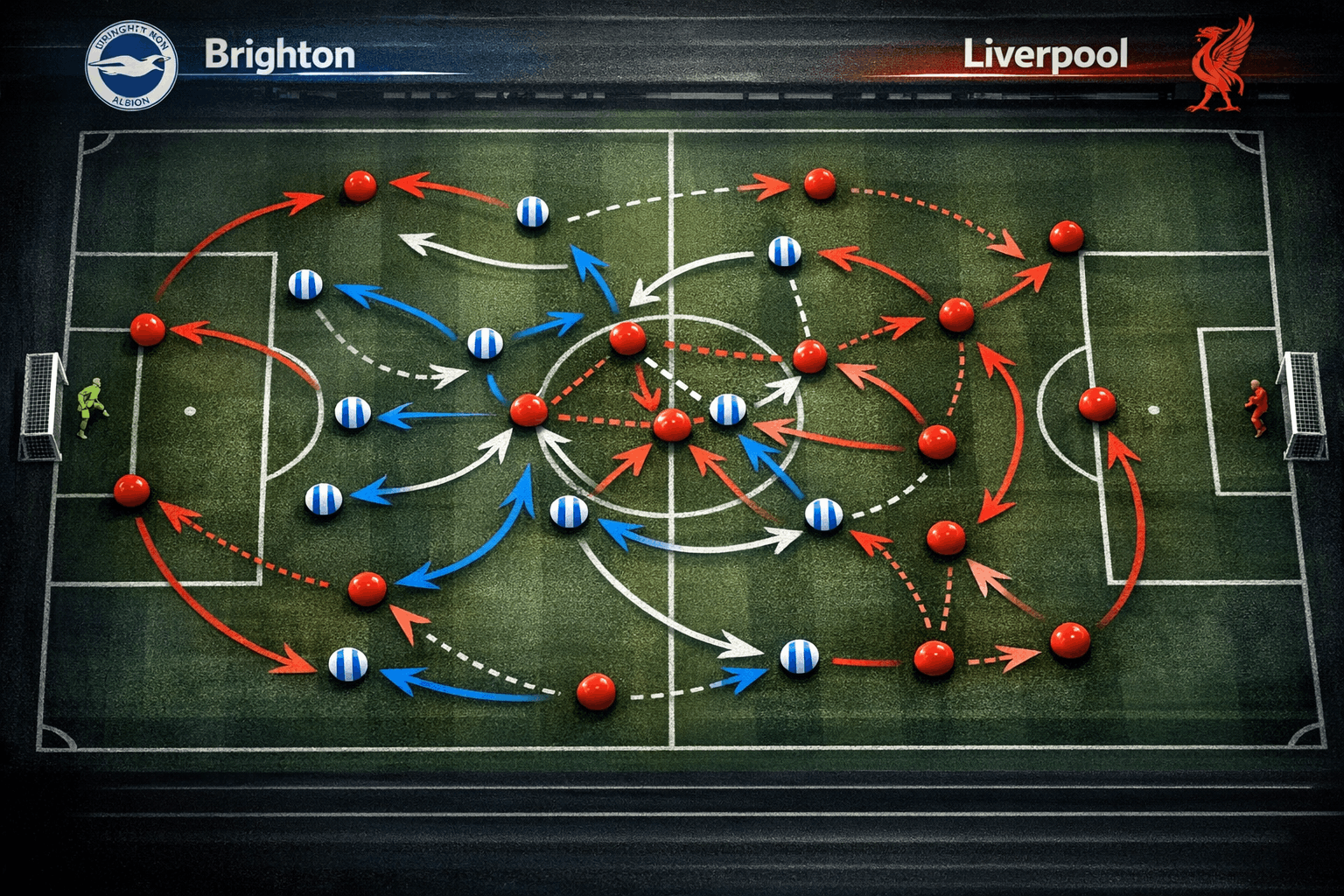
Brighton's 2-1 victory at the Amex was not an accident. It was not a smash-and-grab. It was a precisely engineered tactical masterclass from Fabian Hurzeler — a young manager who has studied Slot's system with forensic detail and identified exactly where to apply pressure to make it collapse. The result was one of the most tactically interesting matches of the Premier League season and a blueprint that every coach facing Liverpool between now and May should be studying obsessively.
Understanding What Liverpool Do — And Why It Makes Them Vulnerable
To understand how Brighton beat Liverpool, you first need to understand what makes Liverpool so dangerous in normal circumstances. Slot's system is built around a high defensive line that compresses the pitch vertically, forcing opponents into a narrow strip of territory in the middle third where Liverpool's press can suffocate them. The full-backs — Frimpong on the right, Kerkez on the left — push enormously high, creating width in attack and forcing opposition wingers to track back rather than threaten. The midfield trio presses in coordinated waves, with specific triggers that send all three towards the ball carrier simultaneously.
This system has two structural vulnerabilities that most teams lack the pace and technical quality to exploit. The first is the space behind the high defensive line — the channel between Liverpool's backline and their goalkeeper that opens up when the line steps up aggressively. The second is the space left by the advancing full-backs — when Frimpong and Kerkez push high, there are large areas on both flanks that only become dangerous if the opposition can play past Liverpool's midfield press quickly enough to exploit them before the full-backs recover.
Brighton had the pace to exploit both. What made their plan exceptional was the precision and discipline with which they executed it for 90 minutes.
The Pressing Structure — How Brighton Turned Liverpool's Strength Into a Weakness
Hurzeler set Brighton up in a 4-2-3-1 shape that shifted into a compact 4-4-2 medium block when Liverpool had possession in their own half. The key was the positioning of the two attacking midfielders — they positioned themselves not to press Liverpool's centre-backs directly, but to block the passing lanes into Liverpool's midfield pivots. This is a crucial distinction. Most teams press Liverpool's centre-backs aggressively, which actually suits Liverpool because it creates space for their midfielders to receive and play forward. Brighton instead forced the ball to stay with Liverpool's defenders for longer than they were comfortable with.
With Liverpool's midfield cut off, their centre-backs had two options — play backwards to the goalkeeper or play long. Brighton's defensive block was organised precisely to deal with both. When Liverpool played backwards, Brighton's press reset and maintained its shape. When Liverpool played long, Brighton's aerial duels were won by Lewis Dunk and the defensive line, with second balls dropping to the midfield duo of Wieffer and Gross who had positioned themselves to collect exactly those moments.
The statistics tell the story with brutal clarity. Brighton had only 47 percent possession — but they had 16 shots to Liverpool's 11. They forced Liverpool into 5 yellow cards through the frustration of a team that could not find solutions to a problem they had not encountered with this level of sophistication all season. Liverpool's normally composed defensive structure gave away 13 fouls as the frustration built. This was not a physical battle Brighton won — it was a chess match, and Hurzeler was three moves ahead throughout.
The Counter-Attack — Pace as the Decisive Weapon
Brighton's offensive plan was as well-constructed as their defensive one. When they won the ball — and their press was designed specifically to win it in the central areas of the pitch where transitions are most dangerous — they committed to vertical passes immediately rather than recycling possession. The instruction was clear: find Mitoma or Minteh in the channel behind Liverpool's full-backs within two passes of winning possession.
Kaoru Mitoma was extraordinary in this role. His goal at 14 minutes came from exactly the pattern Hurzeler had designed — Liverpool's defensive line stepping up aggressively, the pass played in behind before Frimpong could recover, Mitoma's pace carrying him clear of the covering defenders. The finish was composed but the architecture of the chance was the result of weeks of preparation and a tactical plan executed with remarkable precision.
Sponsored
Opta Stats Pro
Advanced football stats and data
The second goal at 56 minutes was even more impressive in its construction. Brighton had absorbed enormous Liverpool pressure in the second half, maintaining their defensive shape through wave after wave of attack. When the moment came to break, they were absolutely clinical — three passes from deep to goal, each one played at pace and with purpose, Mitoma again the key figure. Liverpool's defensive line, which had been stepping up all afternoon, was caught too high at the decisive moment. The result was inevitable.
What Every Manager Facing Liverpool Must Learn
The tactical lessons from Brighton's victory are clear and transferable. The first is that pressing Liverpool's centre-backs directly is counterproductive — it creates the space their system is designed to exploit. Instead, block the passing lanes into midfield and force Liverpool backwards. The discomfort of being unable to play forward disrupts the rhythm that makes Slot's system so effective.
The second lesson is about the high line. Liverpool's defensive line is their most powerful weapon and their most exploitable vulnerability. Teams with genuine pace in their forward line — not just good pace, but exceptional pace in the channel — can punish the space behind it repeatedly. Brighton's front three had the quality to do this consistently. Not every team does, but those that do should be targeting that space from the first minute.
The third lesson is about fitness and timing. Brighton's plan required enormous physical discipline — maintaining the defensive shape under sustained pressure, winning second balls repeatedly, tracking Liverpool's full-backs for 90 minutes. The fact that they held their structure through the second half, when Liverpool were pushing desperately for an equaliser, speaks to the physical preparation and mental fortitude Hurzeler has developed in this squad. Tactical plans only work if the players can sustain them for the full match.
What This Means for Slot Going Forward
Arne Slot will have watched this match back multiple times already. He knows exactly what Brighton did and he knows exactly why it worked. The question is whether he can adjust before Liverpool face opponents who are equally well-prepared and equally capable of executing the same blueprint. The international break gives him time to think but no competitive football in which to implement changes.
The solutions are not simple. Asking the full-backs to sit deeper would reduce Liverpool's attacking threat significantly — Frimpong's forward runs are a fundamental part of how Liverpool create chances. Dropping the defensive line would give opponents more space to play in the middle third but reduce the vulnerability in behind. Neither adjustment is straightforward and both carry costs that could impact Liverpool's effectiveness against teams who are not as well-organised as Brighton.
What Saturday confirmed is that Liverpool are not invincible. They are vulnerable to a specific, sophisticated tactical approach executed with pace, discipline and composure. Whether any other team in the Premier League has the quality and the coaching intelligence to replicate it before the season ends will go a long way towards determining whether Arne Slot wins the title in his first season in English football.
Hurzeler's Masterclass
Football analysis can sometimes feel detached from the human drama of the sport. Not here. Fabian Hurzeler is 31 years old. He took over Brighton in the summer and has continued the remarkable work that his predecessor began building one of the most tactically sophisticated projects in English football. Defeating the title contenders at home, with a plan of this precision and a performance of this quality, is a statement that goes beyond three points.
Brighton will not win the Premier League this season. They probably will not finish in the top four. But moments like this — where a smaller club with a brilliant coach outthinks a giant through preparation, intelligence and execution — are precisely why football at its best is the most compelling sport in the world. Hurzeler took Liverpool apart at the Amex. Every serious football person should understand exactly how he did it.
Discussion 0 comments
Thoughts on this piece? Comments appear right away — keep it respectful; we remove spam or abuse from the admin panel.
Leave a comment