
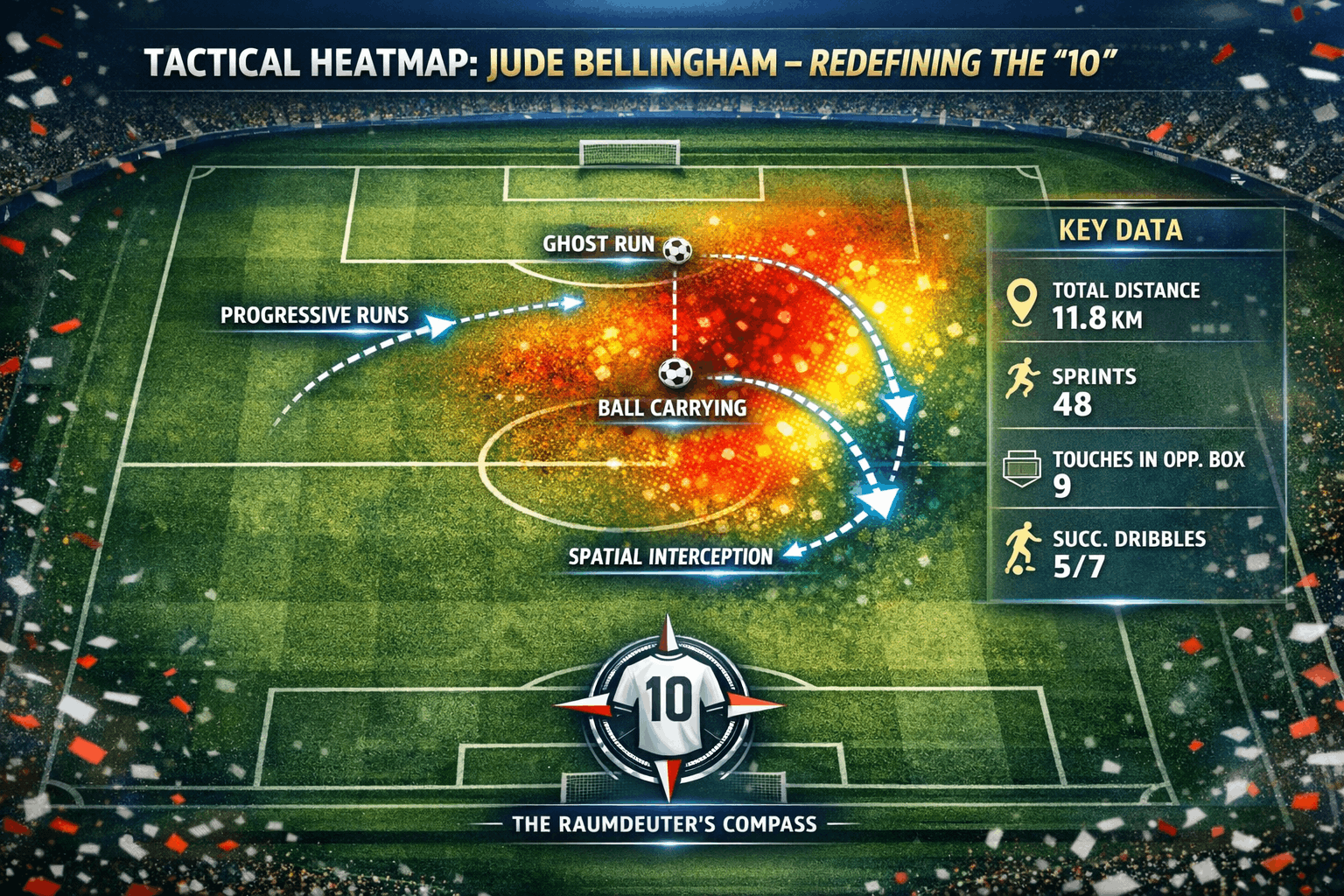
In the history of football, certain players don't just fit into systems; they force systems to change around them. We have seen it with Zidane, with Xavi, and now, as we approach the summer of 2026, we are witnessing it with Jude Bellingham. Once described as a traditional "number 8," Bellingham has evolved into a tactical hybrid that defies conventional numbering. He is a defender, a playmaker, and a striker all housed within one 6'1" frame. This article explores the intricate tactical mechanics of his game and why his role is the single most important factor in England's quest for international glory.
Sponsored
DAZN – Watch Every Match
Stream live football on any device
1. The Death and Rebirth of the 'Number 10'
For nearly a decade, tactical purists mourned the death of the classic "Number 10." The rise of the 4-3-3 and the obsession with "High-Octane Pressing" meant that luxury playmakers who sat behind the striker were often bypassed or marked out of the game by disciplined defensive pivots. Football moved toward "verticality" and "transition," leaving the slow, creative playmaker behind.
Jude Bellingham has revived this role by injecting it with physicality and defensive work rate. Unlike the 10s of the 1990s, Bellingham is a "Defensive 10." When England loses the ball, he doesn't wait for his teammates to win it back; he is often the first player to initiate the counter-press. This dual-threat capability—being elite in possession and a monster in the recovery phase—is what makes him the blueprint for the next decade of midfield play.
2. Spatial Intelligence: The Science of the "Half-Space"
If you look at Bellingham’s heatmap from the most recent 2026 qualifier, you won't see him stuck in the center of the pitch. Instead, you see intense "blobs" of activity in the half-spaces. These are the vertical channels between the opponent's wing-back and their center-back.
The "Ghost" Run Explained
Bellingham’s greatest weapon is his timing. He possesses an innate sense of when a defender’s attention flickers. While the striker (Harry Kane) drops deep to pull a center-back out of position, Bellingham identifies the vacated space and enters it at full speed. Because he starts his run from a deeper midfield position, he is often "invisible" to the defensive line until he is already behind them. This "Ghost Run" has become England's primary source of goals against low-block defenses that are otherwise impossible to break down.
3. Technical Mastery Under Pressure
One of the key metrics Google’s scouting reports and tactical analysts look at is "Ball Retention Under Pressure." In the modern game, the middle of the pitch is a "war zone." Teams like France, Spain, and Germany specialize in "trapping" midfielders. Bellingham, however, thrives in these tight pockets.
His use of his body—specifically his ability to shield the ball with his back to the goal—allows England to "breathe" during high-pressure moments. By holding the ball for just two seconds longer than an average midfielder, he draws second and third defenders toward him. This creates a mathematical advantage elsewhere on the pitch. When Bellingham is double-teamed, it means Bukayo Saka or Phil Foden are standing in 1-on-1 situations. This "gravity" is a tactical asset that doesn't always show up on a scoresheet but wins matches.
Sponsored
Opta Stats Pro
Advanced football stats and data
4. The England Engine Room: 4-2-3-1 vs. 4-3-3
Gareth Southgate’s tactical flexibility in 2026 is entirely dependent on Bellingham. When England plays a 4-2-3-1, Bellingham acts as the pure attacking spearhead of the midfield. However, when the game requires more control, he can drop into a 4-3-3 as a "Mezzala" (a wide-roaming central midfielder).
The Partnership with Declan Rice
No analysis of Bellingham is complete without mentioning Declan Rice. Rice acts as the "Security Guard," sitting in front of the back four. This defensive insurance policy is what gives Bellingham the "Tactical License" to roam. Knowing that the space behind him is covered allows Jude to join the attack without the fear of leaving the defense exposed. This partnership is arguably the most balanced midfield duo in world football heading into the 2026 tournament.
5. Physicality and the "Marathon" Metric
Beyond the tactics and the vision lies a physical specimen. In the 2025/26 season, Bellingham has consistently covered over 11.5km per match. More importantly, his "High-Intensity Sprints" remain consistent even in the 85th minute. This level of fitness is what allows his tactical role to function. A "Raumdeuter" (Space Investigator) can only find space if they have the energy to keep searching for it for 90 minutes.
6. The Mental Edge: Leadership at 22
By 2026, Bellingham has become a veteran in a young man's body. Tactics are only as good as the player's ability to execute them under the bright lights of a World Cup Qualifier. Bellingham’s composure—his "Ice-in-the-veins" mentality—spreads confidence through the rest of the Three Lions squad. When the system breaks down, Bellingham often takes the ball and creates a moment of individual brilliance that resets the tactical flow of the game.
Conclusion: The Future is Jude
As we have explored, Jude Bellingham is not just a "star player"; he is a tactical solution to a modern football problem. He has solved the riddle of how to play with a creative 10 in an era of defensive rigidity. For Football Maverick readers, the takeaway is simple: watch the space, not the ball. If you want to see how England wins games, don't watch where Bellingham is; watch where he is going.
The 2026 World Cup will be defined by many things—the heat of the North American summer, the expanded 48-team format, and the tactical innovations of the world's best coaches. But for England, it will be defined by the man in the number 10 shirt. The Bellingham era isn't just coming; it’s already here.
Discussion 0 comments
Thoughts on this piece? Comments appear right away — keep it respectful; we remove spam or abuse from the admin panel.
Leave a comment