
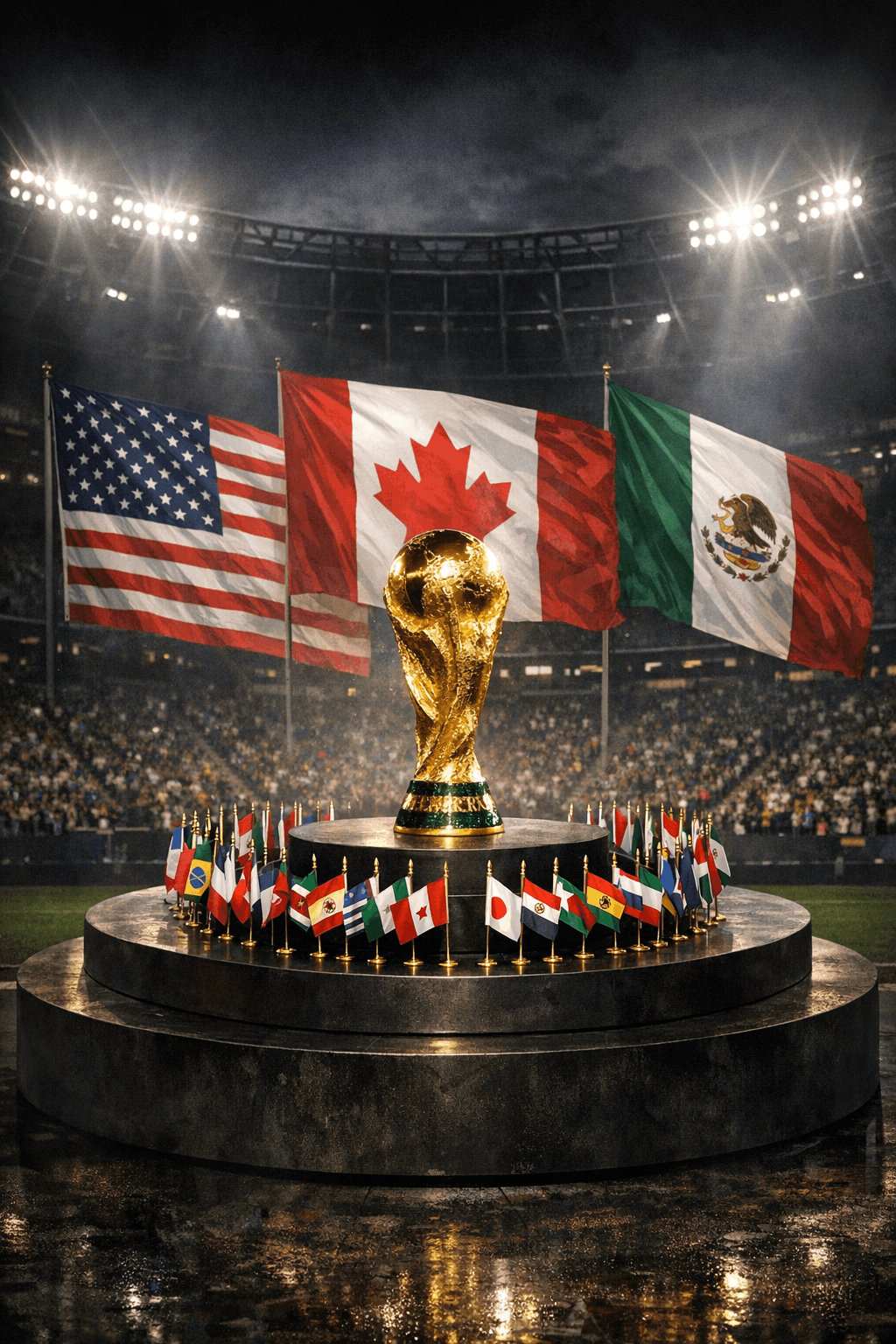
The Field Is Set. Now Let's Be Honest About It.
The 2026 FIFA World Cup roster is complete. All 48 names are on the list. Iraq beat Bolivia 2-1 in the intercontinental playoff final. DR Congo beat Jamaica 1-0. Sweden's Viktor Gyökeres broke Polish hearts with a winner in the 88th minute. Bosnia and Herzegovina knocked out Italy on penalties for the third consecutive World Cup that the Azzurri will watch from their sofas. The drama is done. The qualification window is closed. Now comes the part where we stop being polite and start being honest about who is genuinely going to North America to win this trophy — and who is just going to make up the numbers in the most bloated World Cup field in the history of the sport.
Sponsored
DAZN – Watch Every Match
Stream live football on any device
The expansion to 48 teams is either the greatest democratisation of football or the most cynical cash grab in FIFA's long and storied history of cynical cash grabs. Probably both. But whatever your view on the format, the competitive reality remains unchanged: maybe eight teams can actually win this tournament. The rest are competing for survival, pride, and the occasional giant-killing moment that will flood your social media timeline for 48 hours before everyone moves on. This is the Football Maverick breakdown of the ten teams you actually need to watch — ranked by who can lift the trophy, not who spent the most on their squad or who has the biggest social media following.
#1 — France (FIFA Rank: 1 | Points: 1,877)
France reclaimed the top spot in the April 2026 FIFA rankings after winning friendlies against both Brazil and Colombia during the March international window. That is not coincidence. That is a statement of intent from a squad that has been building towards this moment for four years and is arriving at a World Cup on home-adjacent territory with arguably the deepest squad in international football. Kylian Mbappé at Real Madrid. Mike Maignan between the posts. William Saliba and Ibrahima Konaté at the back. Aurélien Tchouaméni and Khéphren Thuram controlling midfield. This is not a team with one star and a supporting cast. This is a team of stars with depth that would embarrass most club sides.
The knock on France is always psychological. They have the players to win every tournament they enter and they consistently find spectacular ways to implode — 2020 Euros knocked out by Switzerland, 2022 Nations League final disasters, the sense that the team never quite becomes more than the sum of its extraordinary parts. Didier Deschamps has managed this group for over a decade and still cannot answer the question of whether they will hold their nerve when the margin for error disappears. In Group I they face Senegal, Norway and Iraq. They will win the group. The real question is what happens when the tournament genuinely begins.
#2 — Spain (FIFA Rank: 2 | Points: 1,857)
Spain dropped to second after a 0-0 draw with Egypt cost them momentum in the final ranking cycle before the tournament. Do not let that performance fool you into underestimating what Luis de la Fuente has built. The reigning Euro 2024 champions. The 2024 Olympic gold medallists. A squad built around Rodri and Pedri in midfield — two players who make every team they play for functionally superior to their opponents in terms of controlling tempo and recycling possession. Lamine Yamal at 18 years old is already the most complete wide player in international football. Fermín López and Dani Olmo provide the creative depth that allows Spain to shift between systems without losing identity.
Spain are the most dangerous team in this tournament because they can win in multiple ways. They can press you into submission. They can control tempo and bore you to death. They can go direct when they need to. Their squad has genuine competition for every position. In Group H they face Cape Verde, Saudi Arabia and Uruguay — a group they should win comfortably. The path through the knockout rounds will determine everything. If they avoid France until the final, they are the most likely champions. If they meet them in the semis, one of the great sporting spectacles of 2026 will unfold.
#3 — Argentina (FIFA Rank: 3 | Points: 1,840)
The defending champions. Lionel Messi, now 38 years old, confirmed to be travelling to North America for what is certainly his final World Cup. The romanticism surrounding this story is almost unbearable. The greatest player in the history of the sport, returning to defend the trophy that completed his legacy, playing his last competitive matches at the highest level. In Group J they face Algeria, Austria and Jordan — the most comfortable group of any genuine contender. They should reach the knockout rounds without significant difficulty.
The honest question about Argentina is not whether they have the talent to win — they clearly do. The question is whether they have the defensive solidity and midfield control to grind through seven matches against the best teams in the world without their ageing squad being physically broken by the schedule. Scaloni has built a balanced, disciplined team around Messi rather than depending on him entirely. In qualifying, Messi played just 581 minutes — tenth most on the squad — yet still led the team in expected assists and non-penalty goals. When he plays, he changes games. The challenge is managing his minutes intelligently enough that he is fresh for the moments that matter.
#4 — England (FIFA Rank: 4)
England's ranking represents both their genuine quality and the slight inflation that comes from a talent pool that consistently outperforms on paper before crumbling in knockout football. In Group L they face Croatia, Ghana and Panama. They will win that group without serious difficulty. What happens next is where the interesting questions begin. Gareth Southgate is gone. The new era brings new tactical ideas and a squad with genuine depth across every department — Jude Bellingham at Real Madrid leading the pressing intensity, Bukayo Saka providing the kind of reliable wide threat England has not had for decades, a goalkeeping situation that appears finally resolved after years of debate. England can go deep in this tournament. Whether they can go all the way depends entirely on their ability to perform in the knock-out rounds — something this generation has improved at without yet answering definitively.
#5 — Brazil (FIFA Rank: 6)
Brazil's defeat to France in the March window contributed to their slight drop in the rankings, but do not mistake a friendly defeat for a structural weakness. The five-time champions are in Group C alongside Morocco, Haiti and Scotland — a group they will win, probably without breaking sweat. The question around Brazil heading into 2026 is one of identity rather than quality. The post-Neymar era has produced a squad with tremendous individual talent — Vinicius Junior, Rodrygo, Endrick — without yet producing a team that functions with the kind of collective coherence that wins World Cups. Brazil have world-class players in every position. What they need is a tactical system that harnesses them collectively rather than simply relying on individual moments of brilliance. If their manager can solve that problem before June 11th, Brazil are dark horse candidates for the title.
#6 — Portugal (FIFA Rank: 5 | UEFA Nations League Champions)
Sponsored
Opta Stats Pro
Advanced football stats and data
Cristiano Ronaldo at 41 years old, playing at his fourth World Cup, still scoring goals in qualifying, still dominating the squad selection conversation in a way that simultaneously represents the most extraordinary individual longevity in football history and the most persistent structural problem for a Portugal team that has never won the trophy despite having the talent to do so multiple times. The reigning UEFA Nations League champions. A squad that includes Bruno Fernandes, Rafael Leão, Bernardo Silva and Rúben Neves behind Ronaldo. In Group K they face DR Congo, Uzbekistan and Colombia — a group they will navigate comfortably. The real Portugal conversation is always the same: when Ronaldo stops being the best player on the pitch, as he occasionally does now, do they have the collective system to compensate? The Nations League suggests yes. The World Cup will provide the definitive answer.
#7 — Germany (FIFA Rank: Top 10)
The tournament hosts, in the broadest sense, are Germany — a team that has been rebuilding under Julian Nagelsmann with a clarity and purpose that their recent history has sometimes lacked. In Group E they face Curaçao, Ivory Coast and Ecuador. They will win this group without serious challenge. What makes Germany genuinely dangerous heading into 2026 is the emergence of a generation of players who combine technical quality with the pressing intensity that defines the modern game. Florian Wirtz, already proving himself at Liverpool, gives Germany a creative fulcrum they have not had since the peak of Mesut Özil. Jamal Musiala offers the kind of unpredictable dribbling threat that defenders cannot prepare for through analysis alone. Germany are not favourites. They are absolutely capable of going all the way.
#8 — Sweden: The High-Velocity Dark Horse Nobody Is Taking Seriously Enough
This is the pick the Football Maverick Power Rankings are prepared to defend loudly and in public. Sweden qualified for this World Cup by beating Poland in the playoff final through a Viktor Gyökeres winner in the 88th minute — and that moment of clutch delivery under maximum pressure is precisely the characteristic that makes them genuinely dangerous. Gyökeres has been one of the most prolific strikers in European football over the past two seasons. The Sporting CP striker brings a combination of physicality, technical quality and ruthless finishing that very few international defences have the personnel to neutralise consistently.
In Group F they face Netherlands, Japan and Tunisia. They will not be the favourites in that group. They will not be expected to progress comfortably. And that status as perpetual underdogs heading into every match is precisely the environment in which Sweden have historically performed their best football. High-velocity qualifying momentum — they came through a brutal playoff process defeating Poland — combined with a focal point striker operating at the peak of his powers. If Gyökeres fires in North America, Sweden will go further than anyone is predicting. Mark this one down.
#9 — Türkiye: The Comeback Story That Could Shock the World
Türkiye have not appeared at a World Cup since 2002, when they finished third in South Korea and Japan. Twenty-four years later, after beating Kosovo 1-0 in their playoff final, they are back — and they are arriving with significantly more quality than at any point in their recent history. Arda Güler, the Real Madrid midfielder whose creative intelligence has drawn comparisons to the great Turkish playmakers of previous generations, gives Türkiye a match-winning option in central areas that their qualifying campaign demonstrated repeatedly. In Group D they face the United States, Paraguay and Australia — a genuinely competitive group where qualification to the knockout rounds is achievable.
The qualifying momentum point is critical here. Türkiye won their playoff path without conceding a decisive goal in the knockout stage. The defensive organisation their manager has instilled, combined with the creative quality Güler provides and the physical intensity their midfield generates, makes them the team in Group D that nobody wants to play. Two decades of absence from the World Cup stage has produced a hunger in this squad that is palpable. Expect Türkiye to cause significant problems for someone in the knockout rounds.
#10 — Morocco: Africa's Best Chance Yet
The 2022 semi-finalists. A generation of players who proved in Qatar that African football can compete with the very best in the world over the course of an entire tournament rather than simply producing one or two memorable upsets before fading. In Group C they face Brazil, Haiti and Scotland — the most difficult possible group for a team with semi-final ambitions. If Morocco can navigate past Brazil — and their defensive organisation under Walid Regragui makes them genuinely capable of doing exactly that — they possess the squad and the tactical identity to reach the later stages of this tournament.
The momentum Morocco carry into 2026 is qualitatively different from any African team that has preceded them. They have European-based players of genuine quality throughout the squad, a manager who has built a defensive system that makes them extremely difficult to break down, and a collective identity that is stronger than their individual parts. The 2022 semi-final was not a fluke. It was evidence. Morocco in 2026 are the team that could finally deliver Africa's first World Cup final appearance.
The Maverick Verdict: France to Lift the Trophy, Spain to Push Them All the Way
The 48-team format gives more nations their moment. Curaçao, Cape Verde, Jordan and Uzbekistan will experience the World Cup for the first time. Iraq will compete at the tournament for the first time since 1986. DR Congo return for the first time since the 1970s. These stories matter and they deserve to be celebrated. But the trophy will go to one of the teams in the top tier of this ranking — and right now, France's combination of squad depth, ranking momentum and tournament experience makes them the most complete side heading into North America.
Spain will push them. Argentina, with Messi's farewell narrative driving everything, could produce something extraordinary. But the cold Maverick analysis points to France. The most balanced squad. The highest ranking. The momentum. The summer is coming. The 48 are set. Let the arguments begin.
Discussion 0 comments
Thoughts on this piece? Comments appear right away — keep it respectful; we remove spam or abuse from the admin panel.
Leave a comment